Affiliate disclosure: This article contains an OKX partner link. If you register or trade through it, the site operator may receive compensation. User benefits vary by account, region, VIP tier and campaign; check the sign-up page and My Rewards for the terms actually applied.
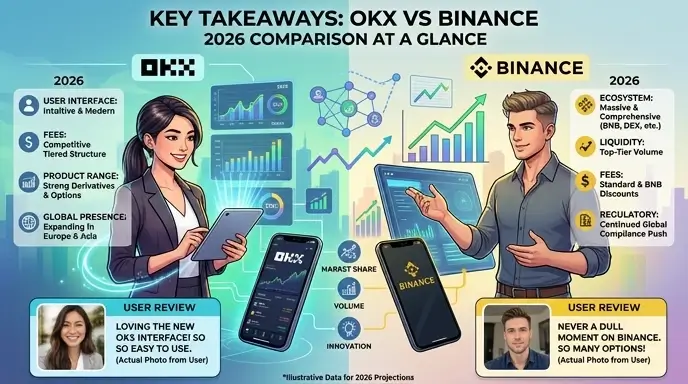
Which exchange is better, OKX or Binance, depends on the type of trading and your country of residence. As of the published rates on August 18, 2026, the basic Maker/Taker rates for general spot users were listed as 0.08%/0.10% for OKX and 0.10%/0.10% for Binance. However, they vary depending on the region, trading pair, VIP, assets held, and promotions, so you should compare them again under the same timing and conditions while logged into your account.
Both exchanges offer spot, derivatives, bots, API, and Proof of Reserves, but their product offerings, fee tiers, Web3 structures, and country restrictions are not identical. This article removes unverified claims about trading speed scores, a security score of 9.8, user satisfaction, and being the industry leader, and compares only each exchange’s official fee, PoR, and terms materials.
Key Comparison: OKX vs Binance
| Category | OKX Published Rates and Features | Binance Published Rates and Features | Points to Note When Comparing |
|---|---|---|---|
| Basic General Spot Rates | Maker 0.08% / Taker 0.10% (basic general spot) | Maker 0.10% / Taker 0.10% (basic general spot) | Based on the page published on 2026-08-18. Varies depending on the region, trading pair, discounts, and VIP |
| Fee Tiers | Regular/VIP tier system based on assets and 30-day trading volume | Structure based on 30-day trading volume, BNB balance, and VIP and BNB payment discounts | Calculate using your account’s actual tier and product-specific rates |
| Trading Products | Spot, perpetual and delivery futures, options, bots/copy trading, API, and more | Spot, margin, USDⓈ-M and COIN-M futures, options, bots, and more | Available menus and eligibility may vary by region |
| Web3 | OKX Web3 Wallet and DEX aggregator ecosystem | Binance Web3 and on-chain-related services | Distinguish recovery responsibilities for exchange accounts and non-custodial wallets |
| Proof of Reserves | 1:1 reserve explanation, Merkle structure with zk-STARK, and on-chain address verification | 1:1 reserve explanation, with user-inclusion verification based on a Merkle Tree and zk-SNARK | PoR is a snapshot and is not equivalent to guaranteeing insurance, all liabilities, or future solvency |
| Korean Users | Officially notifies users that derivatives and P2P may be restricted | Check service and product availability and access in the regional terms and the menus shown after logging in | Do not circumvent restrictions using a VPN, another identity, or duplicate accounts |
Direct conclusion: Based solely on the standard spot Maker rates, OKX’s publicly listed rate on the review date was lower, but the result may change when Binance’s BNB payment discount or each exchange’s VIP·promotions are applied. For futures users, funding fees, spreads, slippage, and liquidation risk may create larger differences than trading fees.
1. Comparing spot fees: How to calculate under the same conditions
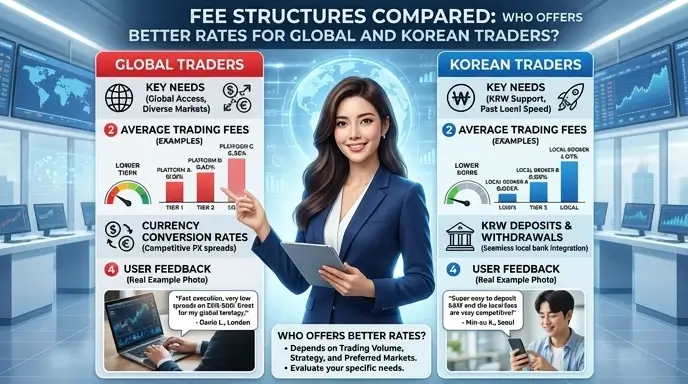
As of the review date, OKX’s official change notice listed the standard spot rates as Maker 0.0800% and Taker 0.1000%, while Binance’s official Fee Rate page showed 0.100%/0.100% for the Regular User Maker/Taker. The Binance page also showed an example of discounted rates of 0.075%/0.075% when BNB fee payment is used under the applicable conditions, reflecting a 25% discount.
These figures should not be applied uniformly to all users. Rate tables may differ by entity and region, including the United States, EEA, and Australia, and conditions for specific stablecoin or trading-pair promotions and VIP may also change.
Spot fee = execution amount × the account’s applicable Maker or Taker rate
For an illustrative executed value of 10,000 USDT, a 0.08% fee has a USDT-equivalent cost of 8 USDT; at 0.10% it is 10 USDT. The actual charged asset depends on buy/sell direction and fee-payment settings; check trade records. Calculate each leg of a round trip from its own executed value and actual rate, then add spread and slippage separately.
The method for calculating the scope of OKX rate and referral applications is explained step by step in the Complete OKX exchange guide.
Like-for-like comparison: when fill mix and discounts change the result
Partial review: 2026-11-01. The OKX page opened in this review was the UK (en-gb) Spot, Standard, Regular schedule at 0.08%/0.10%; Binance showed standard Spot Regular at 0.10%/0.10% and a BNB 25%-off column at 0.075%/0.075%. These are observations of public tables, not eligibility or applicable rates for Korea, every region or every pair. Distinguish them from the existing August 18 snapshot and first match product, pair, VIP and payment conditions in your own accounts.
AKEYX hypothetical calculation: each venue has 10,000 USDT of total executed value in the same spot pair and time, with 70% of that value filled as Maker and 30% as Taker. This is not an order-count ratio; a limit order may also take liquidity. Assume non-promotional trades using regular rates, excluding VIP and referral rebates. The BNB row applies only if the pair/account, fee-payment setting, balance and other discount conditions are satisfied. These are not real transaction records.
| Condition — hypothetical | Maker / Taker rate | Fee — USDT equivalent |
|---|---|---|
| OKX regular | 0.08% / 0.10% | 8.60 USDT |
| Binance regular | 0.10% / 0.10% | 10.00 USDT |
| Binance BNB discount conditions met | 0.075% / 0.075% | 7.50 USDT |
10,000 × (0.70 × 0.08% + 0.30 × 0.10%) = 8.60 USDT
The formula is executed value × (Maker value share × Maker rate + Taker value share × Taker rate), dividing percentages by 100. Under these assumptions, the gap between OKX and regular Binance is 1.40 USDT. If only OKX incurs an additional 1.50 USDT of spread/slippage cost, 8.60 + 1.50 = 10.10 USDT exceeds regular Binance at 10.00 USDT with no extra cost. Equal additional costs preserve the initial gap; meeting BNB conditions can change the order as shown in the discounted row. Neither venue is always preferable.
The table normalizes fee rates into USDT value; it is not the actual USDT debit or net receipt. If a buy fee is deducted from the received coin or paid in BNB, reconcile the actual quantity and contemporaneous conversion rate with trade records. BNB quantity is not calculated here. Spread/slippage are excluded from the table apart from the sensitivity example; withdrawal fees, BNB holding cost/price risk and rebates are also excluded. Do not use this spot example as a futures-margin or funding calculation.
Regional and product eligibility comes before cost comparison. For PoR, check each snapshot time, included assets and inclusion of your own balance; reserve ratios alone do not rank security. This partial review covers fee comparisons, charged assets, PoR scope and restriction disclosures, not new hands-on testing of every feature in the article. Official sources: OKX — Spot fees · Binance — Spot fees · OKX — PoR · Binance — PoR · OKX — US risk / jurisdiction disclosures
2. Futures costs: Why comparing only trading fees is incorrect
The total cost of perpetual futures must include trading fees, spreads, slippage, and funding fees. Leverage does not reduce the fee rate; because it allows a larger notional value to be traded with a smaller margin, it may increase actual costs and liquidation risk.
Futures total cost = entry fee + exit fee + cumulative funding fees + spread and slippage + potential losses related to liquidation and ADL
- Compare using the same contract’s notional value and holding period.
- If a Maker order is not actually filled, Taker conversion or an opportunity cost may arise.
- Funding fees are separate from exchange trading fees and may be positive or negative.
- Check the maintenance-margin and liquidation calculations, as well as the rules for cross and isolated margin.
OKX order types, Reduce-only, and TP/SL can be checked in the OKX futures order types guide, while funding fees are covered in the OKX funding fee guide.
3. Comparing products and trading tools
| Purpose of use | Features to verify directly in an OKX account | Features to verify directly in a Binance account | Selection criteria |
|---|---|---|---|
| Simple spot | Spot, Convert, order types | Spot, Convert, order types | Desired trading pairs, actual spreads, deposit and withdrawal networks |
| Perpetual futures | USDT/USDC/availability of coin-margined products, unified account | Availability of USDⓈ-M/COIN-M | Regional eligibility, maintenance margin, funding fees, order functions |
| Automation | Automation tools such as Grid, DCA, Signal, Arbitrage, and API | Trading Bots·API | Backtesting limitations, API key security, emergency shutdown |
| Copy trading | Lead traders, copy settings, and risk disclosures | Copy-trading features available in the account | Performance period, maximum drawdown, fees, slippage, regional availability |
| Web3 | Non-custodial OKX Wallet·DEX routes | Binance’s Web3·on-chain features | Seed phrase control, DApp·bridge·gas fee risks |
The fact that “there are more features” does not necessarily mean that it is more suitable. Products you do not use may only increase UI complexity and the risk of mistakes, so it is better to first identify the three features you actually need and compare them.
4. Security and Proof of Reserves: Compare the scope of verification instead of scores
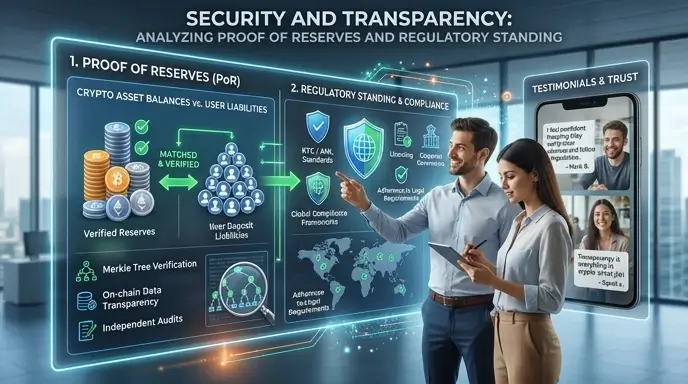
Both OKX and Binance provide Merkle-based PoR materials that allow users to verify whether their balances were included in the proof of reserves. OKX explains verification using zk-STARKs, on-chain addresses, and reserve ratios, while Binance describes inclusion verification based on a Merkle Tree and zk-SNARKs.
There is no basis for rating either one with an arbitrary “security score of 9.8.” PoR is a tool that enhances the transparency of reserves for a specific point in time and a specified range of included assets; it does not guarantee the following.
- All legal and operational liabilities and future solvency
- Elimination of cyber incidents, insider threats, and third-party custody risks
- Deposit insurance or principal protection
- Protection against phishing or API key compromise of user accounts
Both exchanges require separate configuration of passkeys or strong 2FA, anti-phishing measures, withdrawal address verification, and least-privilege API access with IP restrictions. You must also decide how to distinguish funds held for long-term storage from funds used for trading.
5. The biggest difference for Korean users: products actually available
Even if you can access the website or install the app, this does not mean that spot, derivatives, P2P, Earn, and fiat currency features are all available. OKX’s official regulatory documents state that derivatives and P2P services for Korean users may be restricted. Binance may also have different local entities, terms, and product menus by region, so you must check the account you are logged into and the latest local terms.
Bypassing restrictions through a VPN, using another person’s identity, entering a false residence, or creating duplicate accounts increases the risk of account freezing, withdrawal reviews, and terms-of-service violations. Check the OKX Korean account verification procedure in OKX availability and regional restrictions guide.
6 Steps to Choose the Right Exchange for You
- Regional eligibility: Confirm that your country of residence and the products you need are actually available in your KYC account.
- Monthly trading pattern: Record your spot/futures ratio, Maker/Taker fills, average notional value, and holding time.
- Total cost calculation: Add trading fees, funding fees, spreads, slippage, withdrawal costs, and the opportunity cost of holding tokens.
- Feature testing: Use a small amount or demo account to verify orders, TP/SL, position closing, and deposits and withdrawals in practice.
- Security settings: Set up 2FA/passkeys, anti-phishing protection, withdrawal allowlists, and minimum API permissions.
- Quarterly review: Recheck the fee schedule, VIP, regional terms, PoR, and approvals for unused APIs and DApps.
| Priority | Conditions to prioritize |
|---|---|
| Spot limit-order cost | Your actual Maker tier on OKX and Binance, discount-token costs, and the actual spread |
| Short-term futures trading | Actual Taker rates, liquidity, funding fees, liquidation and order tools, and regional eligibility |
| Automation/API | Permission controls, IP restrictions, error handling/retries/emergency stops, and API documentation |
| On-chain use | Self-custody capabilities, supported chains, and DEX/bridge/gas fee risks |
| Long-term storage | PoR scope, platform and custody risks, and your ability to secure a personal wallet |
What to check when choosing OKDCC
The referral code AKEYX of OKDCC is relevant only to signing up for OKX. Check the code and the displayed fee benefits and eligibility requirements on the sign-up screen, then verify the actual application status in My Rewards after signing up. Even if the official maximum range is stated, it may vary depending on the account, region, VIP, and campaign. Do not mix these with Binance’s terms when comparing them; check only the OKX screen in OKX referral code verification guide.
Frequently Asked Questions
Are spot trading fees always lower on OKX?
That cannot be stated categorically. On the review date, OKX had the lower standard base Maker rate, but the results may differ when Binance’s BNB discount and both platforms’ VIP, regional, and trading-pair conditions are applied.
Which is cheaper for futures trading?
You should compare your account’s futures Maker/Taker, funding fees, spread and slippage, and holding period at the same point in time. Leverage and liquidation risk should also be assessed before costs.
If both exchanges have PoR, are they completely safe?
No. PoR improves reserve transparency, but it is a snapshot and does not mean insurance, coverage of all liabilities, future solvency, or elimination of account phishing risks.
Can users in South Korea use futures on both OKX and Binance?
You must check each exchange’s login account and the latest regional terms. OKX officially states that derivatives and P2P access for users in South Korea may be restricted.
Do the OKDCC benefits also apply to Binance?
No. OKDCC is an OKX signup code and is unrelated to Binance accounts or fees. Check the actual application status only on the OKX signup screen and in My Rewards.
Official Sources and Comparison Date
- OKX official: Latest regional and account-specific fee schedule
- OKX official: Notice of changes to standard spot rates effective 2026-08-14
- OKX official: Proof of Reserves and verification method
- OKX official: Country, regional, and product restrictions
- Binance official: Spot, futures, and VIP fee schedule
- Binance official: Proof of Reserves and verification method
Comparison date: August 18, 2026. Fees, VIP, supported trading pairs and products, regional regulations, and PoR figures may change. The figures above are conditional snapshots from publicly available pages on that date, and you should recheck each exchange’s logged-in page immediately before signing up or trading. AKEYX is an independent information provider and does not guarantee the safety, profitability, or superiority of either exchange.