Affiliate disclosure: This article contains an OKX partner link. If you register or trade through it, the site operator may receive compensation. User benefits vary by account, region, VIP tier and campaign; check the sign-up page and My Rewards for the terms actually applied.
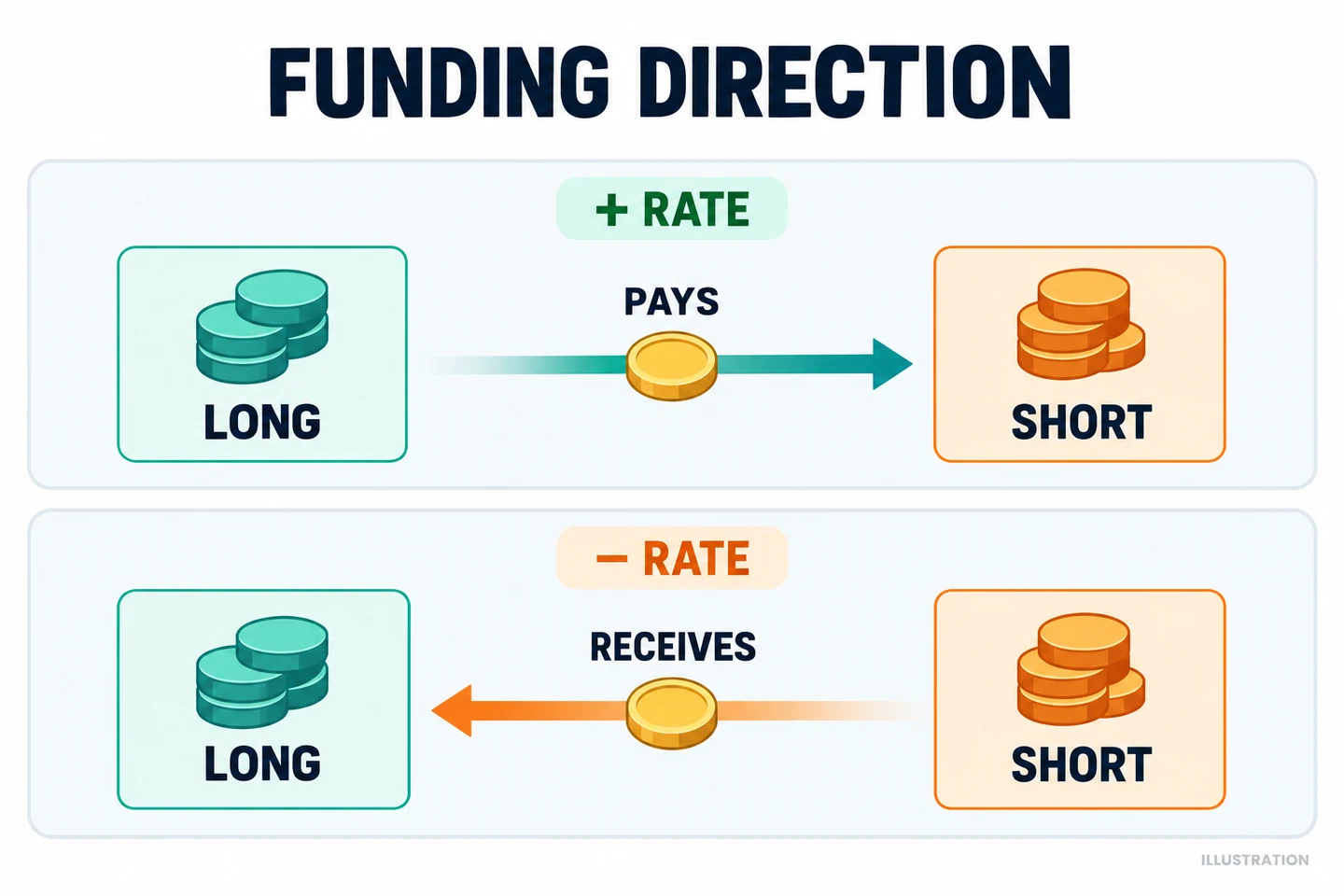
OKX Funding is an amount exchanged between holders of long and short positions at the settlement time of a perpetual contract. It is different from trading fees charged when an order is filled or borrowing interest. When the funding rate is positive, longs pay shorts; when it is negative, shorts pay longs. The default settlement interval is 8 hours, but 1-, 2-, and 4-hour contracts and exceptions involving interval changes are available, so check the rate, interval, and countdown for each contract.
This article is educational material explaining the calculation and verification procedures. OKX The official risk disclosure states that derivatives-related and P2P services may be restricted in Korea. The presence of a menu or completion of KYC does not confirm eligibility to use a service; you must separately verify the conditions related to your residence, account, and product, as well as applicable laws and regulations. We do not provide instructions for bypassing restrictions using a VPN, another identity, or duplicate accounts.
Scope of official source review: October 23, 2026. We reviewed the funding mechanism, FAQ, calculation changes, automatic settlement interval announcements, and regional risk disclosures. We did not verify the actual rate or feature availability for any individual account, or any trading results. The illustration below is an AKEYX commissioned explanatory diagram and is not an actual OKX screen.
How are funding and trading fees different?
Because perpetual contracts have no expiry, they use a funding mechanism to prevent the contract market price from diverging too far from the spot index price. According to OKX's official explanation, the platform does not collect funding as a separate service fee; it facilitates the exchange between holders. Positive and negative rates indicate the direction of payment and are not signals that guarantee a price rise, fall, or reversal.
| Category | Conditions for incurrence and items to check |
|---|---|
| Funding | Check whether you hold a position at settlement, the position value, and the rate for that settlement. You may pay or receive funding. |
| Trading fee | Charged when an order is filled. Check the Maker/Taker rates and trading amount for the product and account. |
| Borrowing interest | A cost for a separate product that uses borrowing. It is not calculated as the same item as funding. |
For calculations of execution costs, see OKX Spot and Futures Fee Guide. For the basic structure of leverage, margin, and liquidation, see Futures Trading Basics. You may incur both costs, so do not assess holding costs based on funding alone. Source: Official Funding Mechanism.
Funding calculation: based on position value, not margin
Funding = position value at settlement × funding rate for that settlement. The official position value formula for USDT·USDC-margined perpetual contracts is number of contracts × contract size × contract multiplier × mark price. Contract units, multipliers, and settlement currencies may vary by product, so check the contract information first.
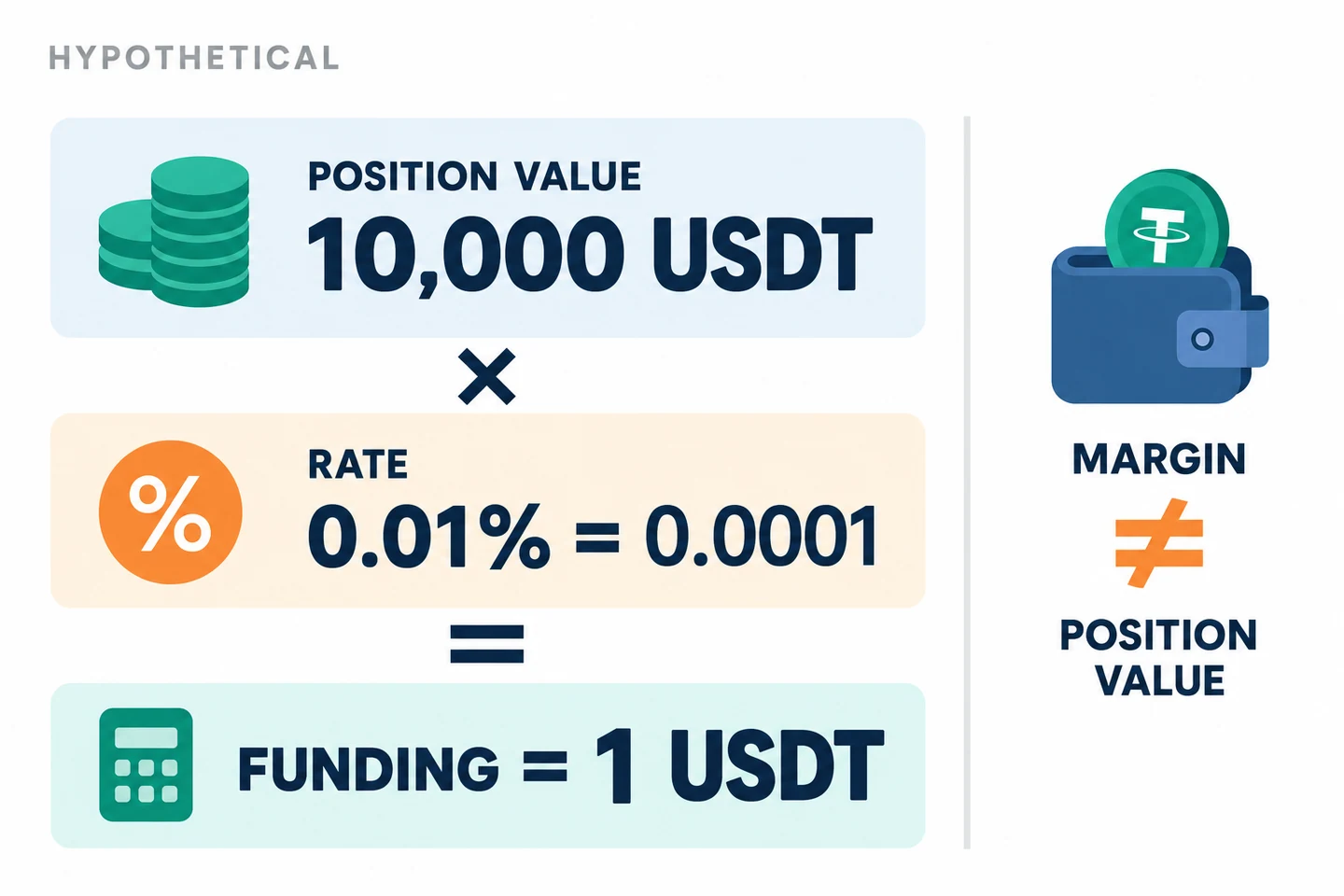
AKEYX Hypothetical example: In a USDT linear contract, if the position value at settlement is 10,000 USDT and the rate is +0.01%, then 10,000 × 0.0001 = 1 USDT. The long pays 1 USDT and the short receives it. At the same position size, a rate of −0.01% reverses the payment direction. This example excludes trading fees, price gains and losses, spreads, slippage, and currency conversion and withdrawal costs.
Simply changing the leverage setting does not increase the funding rate. For the same contract, time, and position value, the funding amount calculated by the formula is the same regardless of the leverage multiplier. This means that if you use the same margin to create a larger position, its value may increase, resulting in a higher amount. For example, distinguish the simple assumption of using 1,000 USDT in margin to create a 10,000 USDT position equivalent to 10x leverage from adjusting only the margin of a position already worth 10,000 USDT. Higher leverage can also increase liquidation risk.
The same USDT formula cannot be used as-is for coin-margined contracts. The official formula is number of contracts × contract size × contract multiplier ÷ mark price. AKEYX Hypothetical example: If the number of contracts is 100, the size is 10 USD, the multiplier is 1, and the mark price is 4,000 USD/ETH, the value is 100 × 10 ÷ 4,000 = 0.25 ETH. The amount at a rate of 0.01% is 0.25 × 0.0001 = 0.000025 ETH, not 0.000025 USDT. This is a hypothetical example for explaining units, not an actual contract specification, current price, or rate.
How are costs across multiple settlements added up?
Apply the position value and finalized rate separately for each settlement, then add up payments and receipts separately. Simply adding the rates and multiplying by the current position value may be incorrect if the past quantity or mark price was different. AKEYX Hypothetical example: For a long position worth 10,000 USDT at all three settlements, if the rates are +0.01%, +0.02%, and −0.01%, then payment of 1 + payment of 2 − receipt of 1 = net payment of 2 USDT. This assumes the value and currency remain the same and excludes other costs and price gains or losses.
Recalculate each settlement if the position value changed. The example above assumes a constant value. The following example instead assumes a long USDT-linear position worth 10,000, 6,000, and 8,000 USDT at three respective assessments. The rates of +0.01%, +0.02%, and −0.01% are hypothetical, not current market rates, and the position is assumed to qualify for funding at each assessment.
| Assumption and calculation per settlement | Long position pays or receives |
|---|---|
| First: 10,000 × 0.0001 | Pays 1 USDT |
| Second: 6,000 × 0.0002 | Pays 1.2 USDT |
| Third: 8,000 × (−0.0001) | Receives 0.8 USDT |
| Net paid: 1 + 1.2 − 0.8 | 1.4 USDT |
This differs from multiplying today’s 8,000 USDT value by the three rates’ sum of 0.02%, which gives 1.6 USDT: that shortcut incorrectly replaces earlier assessment values with the current value. Net payment is shown as positive here; check how expenses and income are signed and displayed in the actual ledger. Price P&L, trading fees, spread, slippage, and other costs are excluded. Reconcile actual amounts against the contract information, mark price, settlement currency, and account record at each assessment.
Settlement times and Korea time: not always three times a day
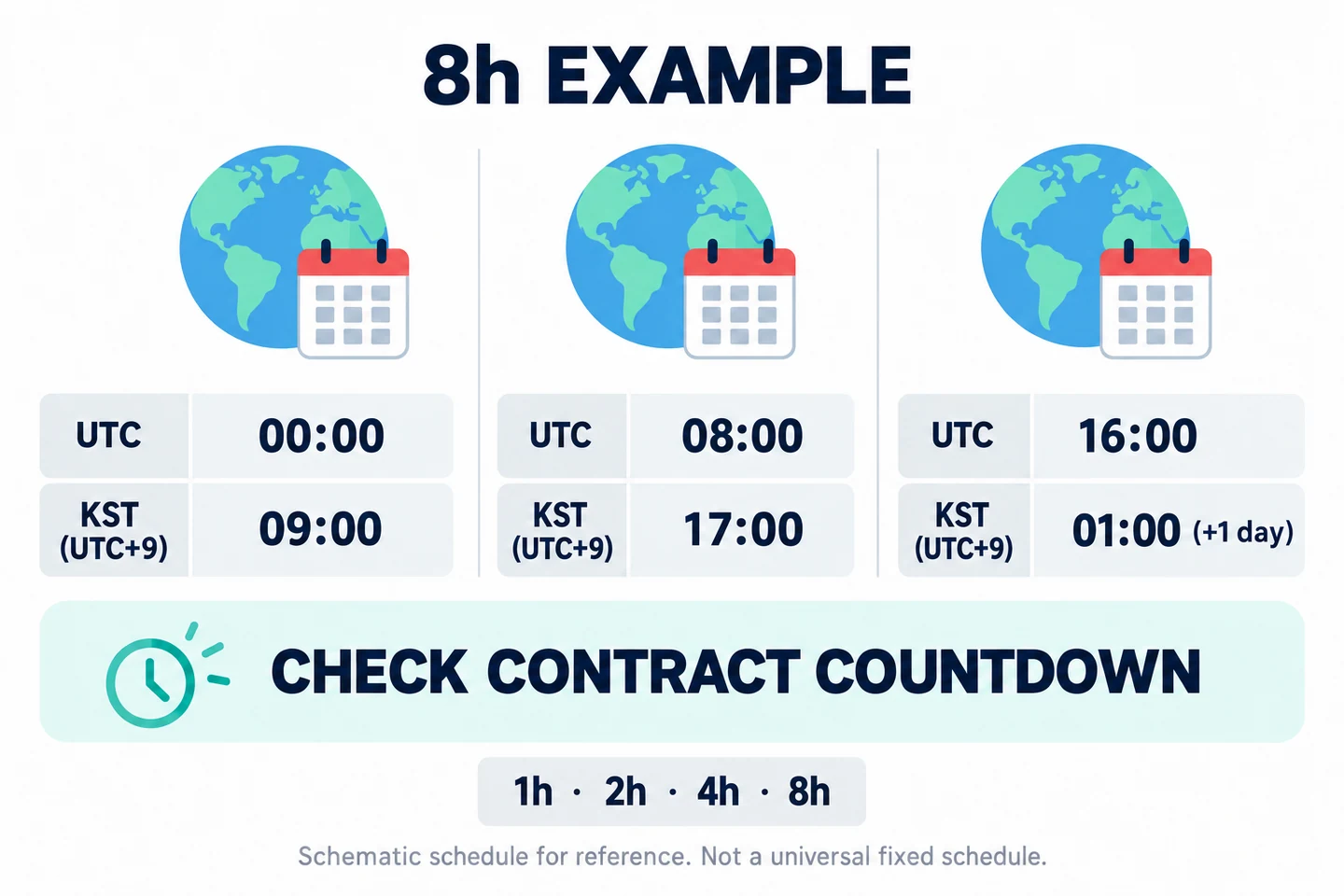
The settlement times for standard 8-hour contracts are 00:00, 08:00, and 16:00 UTC. In Korea, which is UTC+9, these correspond to 09:00, 17:00, and 01:00 KST the next day; listed by Korean calendar day, they are 01:00, 09:00, and 17:00. The table and illustration below are provided to help explain schedules by interval; they are not fixed schedules that apply to every instrument.
| Interval | UTC settlement schedule | KST, by calendar day |
|---|---|---|
| 8 hours | 00:00, 08:00, and 16:00 | 01:00, 09:00, and 17:00 |
| 4 hours | 00:00, 04:00, 08:00, 12:00, 16:00, and 20:00 | 01:00, 05:00, 09:00, 13:00, 17:00, and 21:00 |
| 2 hours | Every 2 hours starting at 00:00 | Every 2 hours starting at 01:00 |
| 1 hour | On the hour | On the hour |
According to the official documentation, settlements are evaluated to the millisecond for each contract, but processing may take up to about 1 minute to complete. The documentation gives the example that opening a new position at 00:00:20 UTC may still be included in that settlement if evaluation has not finished. If a position is properly closed before settlement evaluation, it is not included in that settlement; however, there is no guarantee that an order placed at the boundary time will be filled at the desired moment. Do not rely on timing an order as a guaranteed way to avoid costs.
Conditions for automatic interval reductions and returning to the default interval
The announcement dated April 14, 2026, and the current mechanism explain that when the rate at settlement reaches the contract's upper or lower limit, the interval is reduced one step at a time: 8 hours → 4 hours → 2 hours → 1 hour. After the change, the first settlement takes place at the next scheduled settlement time for the new interval. For example, if a standard 4-hour contract changes to a 2-hour interval at 16:00 UTC, the next scheduled settlement is at 18:00 UTC.
Returning to the default interval does not happen immediately just because the current rate has fallen. At a settlement time on the standard schedule, the system evaluates whether all settlement rates during the preceding continuous 12 hours were within ±0.20% (20 bp); if the condition is met, the interval may revert without a separate announcement. Automatic adjustment may be disabled for certain contracts. This automatic adjustment applies to crypto perpetual contracts and excludes perpetual contracts on traditional financial assets such as stocks, ETFs, and commodities. Give priority to the latest contract information. Source: Official Announcement on Automatic Settlement Interval Adjustments.
What does the 8/N factor in the funding rate formula mean?
The formula for the funding amount differs from the formula used to calculate the rate. The official guidance set out a schedule to apply the new calculation logic on June 1, 2026, and migrate contracts in stages by June 4. The interest term in the current documentation is fixed at 0.01%, and N is the number of hours in the settlement interval (1, 2, 4, or 8). This does not mean the actual funding rate is always 0.01%.
The calculation first adds to the average premium index P a value of 0.01% − P limited to the range −0.05% to +0.05%, to obtain the base value B. Then B is divided by 8/N, after which the contract-specific lower and upper limits are applied. That is, assuming the same base value, the calculation is ÷1 for 8 hours, ÷2 for 4 hours, ÷4 for 2 hours, and ÷8 for 1 hour. The finalized rate for each settlement is not divided again.
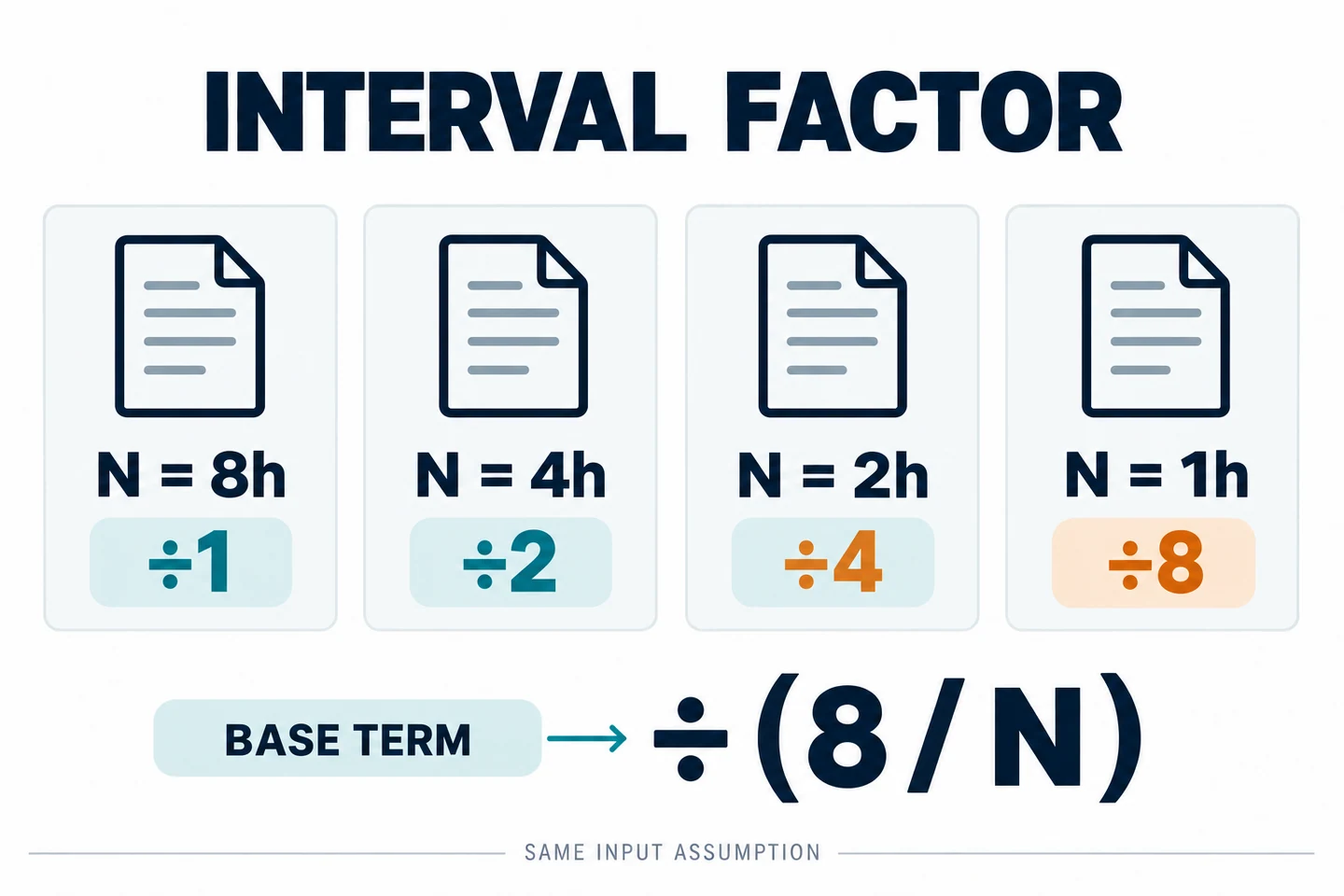
Conditions in the official calculation example: With an average premium of 0.10% and an interest component of 0.01%, the difference of −0.09% is capped at −0.05%, and the base value is 0.05%. For a 1-hour contract, 0.05% ÷ 8 = 0.00625%, assuming the contract cap and floor do not apply. Premiums and contract limits can change, so do not use this example as the current rate or a fixed return. Original formula and implementation schedule: Official notice of changes to the funding rate formula.
Distinguishing estimated rates, historically settled rates, and payment records for your account
The estimated rate shown on screen may change until settlement and does not prove the payment or receipt amount in your actual account. First match the contract, time zone, interval, and settlement currency, then compare the historically settled rate with your account records. The following paths are based on the official FAQ reviewed; names and locations may vary depending on the app version and account.
Match the reference time of the rate used in the assessment as well. The official mechanism, updated October 28, 2026 and viewed on November 5, states that assessment uses the latest rate calculated in the previous minute. Its example uses the rate calculated at 15:59 UTC for the 16:00 UTC assessment. Do not substitute an earlier screenshot’s estimated rate for the settled rate; match the history for the relevant assessment to the actual account record. This identifies the rate’s reference time, which is distinct from the assessment processing time described above.
| Records to check | Where to check in the official guide and what it is for |
|---|---|
| Current rate and interval | In the app: Trade → Futures → Perpetual instrument → Candles → Info → Funding rate. On the web, check Funding rate / Countdown at the top of the contract page. |
| Historically settled rate | Check historical records under Funding rate / Countdown for the contract in the app. These are different from actual payment records reflecting your position size. |
| Actual account settlement | In the app: Assets → History → Trading → Trading history; on the web: Assets → Order center → Trading history. Select Perpetual for Instrument and Funding rate for Type to check Funding fee expense/income. |
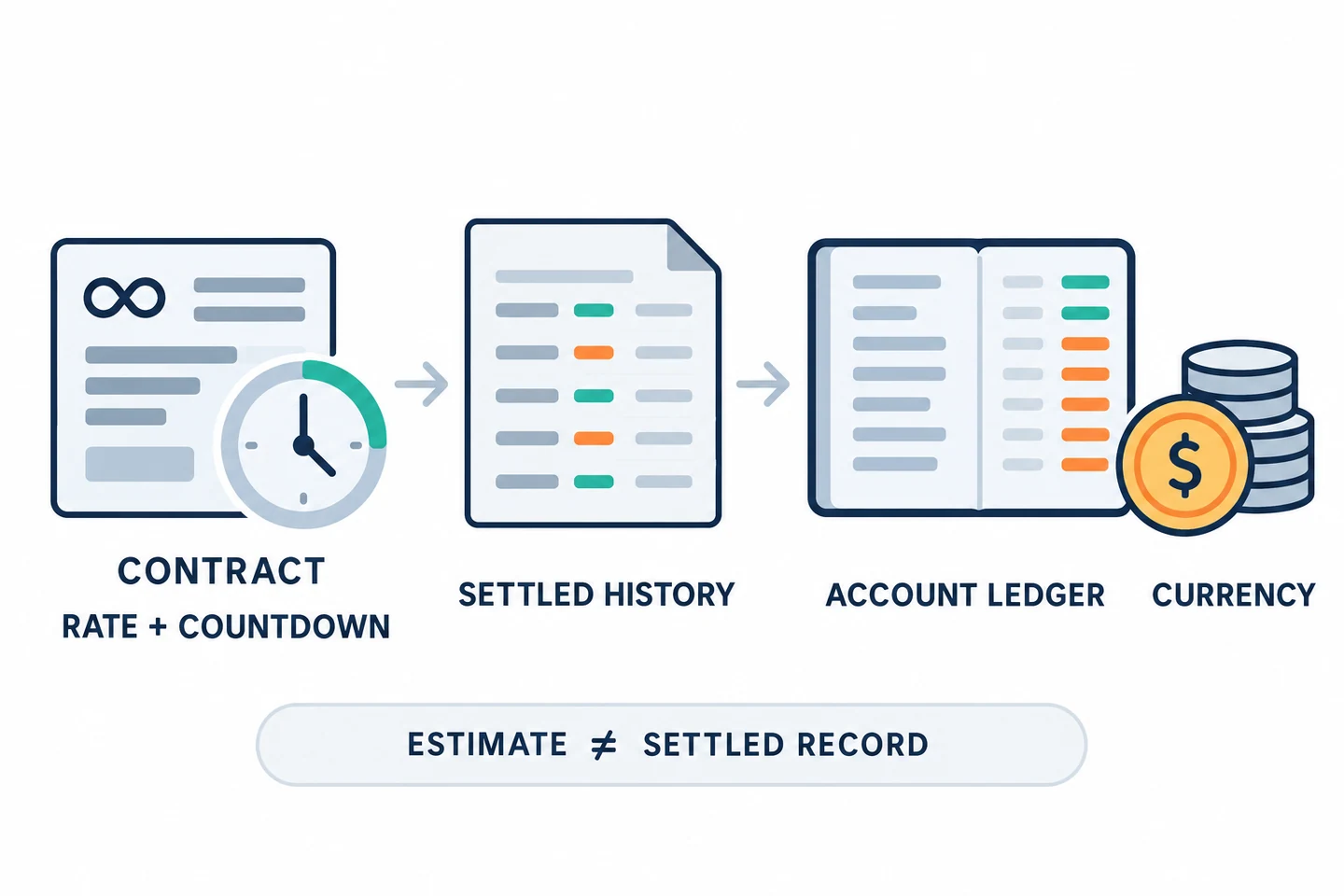
If the rate and countdown are not visible on the web, you can check the screen expansion and Advanced mode described in the official FAQ. If your account records differ from expectations, check the instrument and contract type, position size and value at the time, execution times before and after settlement, time zone, and settlement currency. Provide only the necessary records when contacting official customer support; do not share your password or API secret key. Source: Official funding fee FAQ and path for checking payment records.
Why you can still lose money even when you receive funding fees
Funding fees are settled separately from price gains and losses. Being on the receiving side is not, by itself, a reason to open or maintain a position. Nor can the actual number of long or short holders be determined, or a price reversal predicted, based solely on the rate's sign. A sharp rate change is a reason to further assess premiums, liquidity, and market imbalances, not a definitive trading signal.
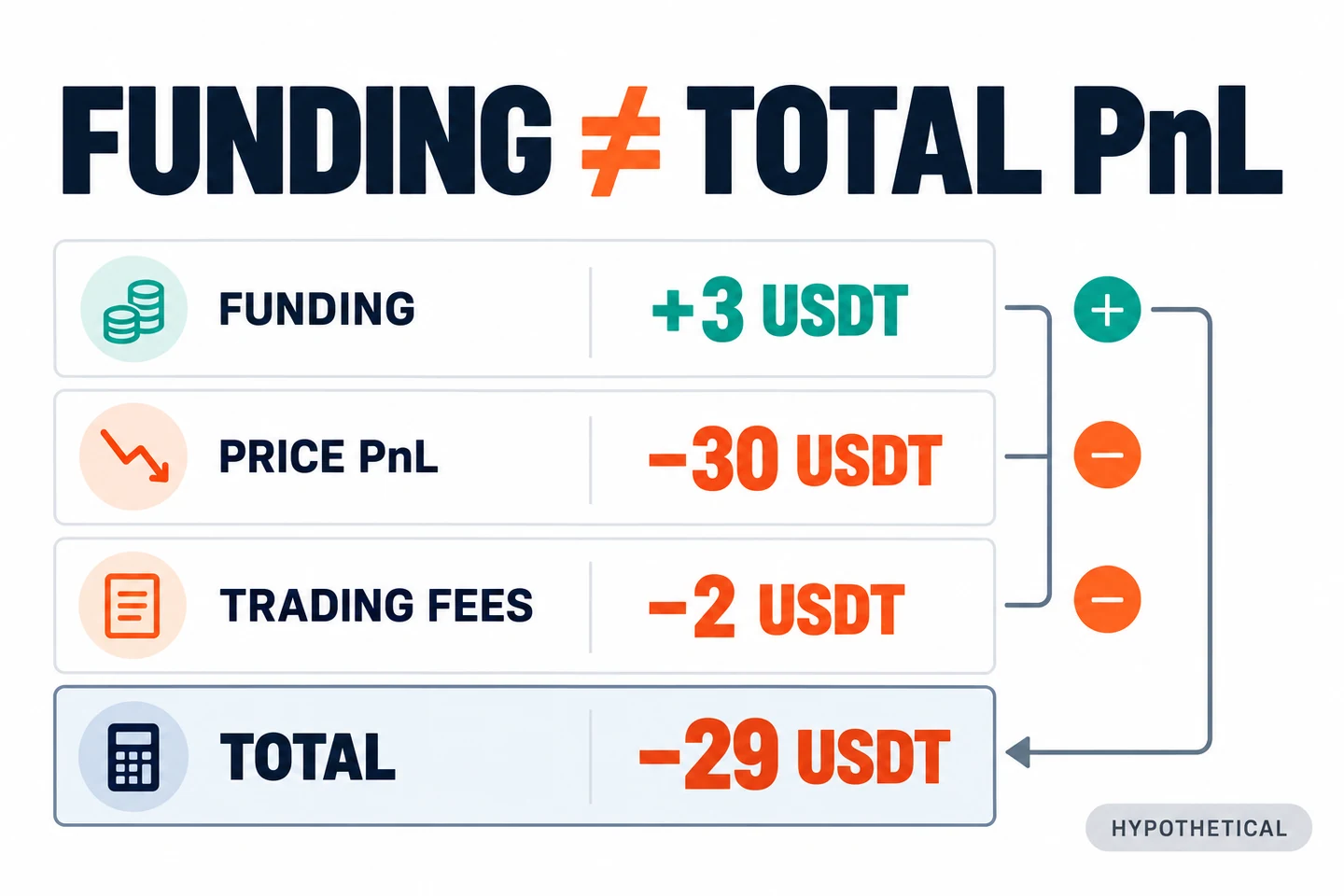
As in the example, even if you receive a funding fee of +3 USDT, if the price loss is −30 USDT and the separate trading fee is 2 USDT, the total is −29 USDT. Check whether costs are already included in the P&L metrics on the actual screen to avoid deducting them twice. Calculations may be incorrect if you combine figures from different sources that include unrealized P&L, realized P&L, funding fees, and fees differently.
| Scenario | What to check when assessing amounts and risks |
|---|---|
| Funding fee deduction | In isolated margin, the deduction is reflected in the margin for that position; in cross margin, it is reflected in the account's asset value for the relevant currency. If the deduction reduces asset value, the position may be reduced or liquidated. Do not assume that open orders are automatically canceled. |
| Spot-futures hedge | Even if quantities are matched, basis changes, execution on only one side, fees, slippage, collateral fluctuations, and insufficient futures margin remain risks. This is not a risk-free or principal-protected strategy. |
| Rate reversal | An expected receipt may turn into a payment. Do not calculate the next interval's rate as a fixed return. |
| Low liquidity | A high rate does not mean a better trade. Check for partial fills, sudden price changes, liquidation risk, and whether you can actually exit. |
The comparison above is not a star rating or profitability ranking; it explains conditions that can change P&L. Before trading, check contract eligibility, interval and countdown, actual position value and currency, cumulative payments/receipts, trading costs, margin, and liquidation risk. If there is a problem, checking records and contacting official support should take priority over increasing your position to recover losses.
Account terms and OKDCC guides are separate from funding fees
For the usual account and product verification process, OKX review the terms of use and key guidelines, and OKDCC check the input and eligibility requirements in the Code Requirements Guide. Do not assume that referral codes or trading fee benefits waive funding fees or compensate for losses. The actual rates, duration, and eligible trades may vary by account, region, VIP level, and campaign. Check the applicable terms on the screen before signing up and in My Rewards after signing up, and contact official customer support to confirm whether existing accounts can change channels.
Frequently asked questions
Q. Are funding fees exchange fees or loan interest?
A. No. They are settlement payments exchanged between long and short holders of perpetual contracts. According to the official explanation, OKX does not charge a separate service fee for this mechanism. They are distinct from trading fees and borrowing interest.
Q. Does changing leverage alone change the funding fee?
A. For the same contract, time, and position value, the amount is the same according to the formula. If you increase the position value while keeping the same margin, the amount paid or received may also increase. The rate is not applied to the margin itself.
Q. Is settlement only at 01:00, 09:00, and 17:00 Korea time?
A. This is the schedule for a standard 8-hour contract based on the Korean day. Since there are 1-, 2-, and 4-hour contracts and exceptions for interval changes, check the actual interval and countdown to the next settlement on the contract screen.
Q. When does a shortened settlement interval return to the standard interval?
A. The official rules state that it returns to the standard schedule if, at a settlement time in that schedule, all settlement rates over the immediately preceding 12 consecutive hours are within ±0.20%. Automatic adjustment may be disabled for certain contracts, and perpetual contracts for traditional financial assets are excluded from this automatic adjustment. Give priority to the latest contract information.
Q. Where can I distinguish the estimated rate from the funding fee actually received?
A. Check the estimated rate and interval on the contract screen, and actual payments or receipts in Trading history in your account, using the Perpetual and Funding rate filters. Compare by matching the contract, interval, position value, and settlement currency; do not infer the actual account amount from historical rates alone.
Q. If I receive a funding fee, does that mean the overall trade is profitable?
A. No. Price losses and trading costs may exceed the funding fee received, and liquidation is also possible. Check what is included in price P&L, funding fees, and trading fees to avoid double-counting.
Official source review date: October 23, 2026. This is general educational information, not investment, legal, or tax advice. Crypto assets and leveraged derivatives involve the risk of losing all principal, liquidation, counterparty risk, and system risk. The publication and revision dates of official documents differ from the AKEYX review date, and individual account and contract terms should be checked again before use.
Partial review on 2026-11-05: the official funding mechanism updated October 28 and the funding-fee FAQ were compared. The payment direction, position-value formulas, general schedule, and automatic frequency-adjustment explanation were retained. Only the changing-value cumulative calculation and the rate’s reference time were expanded. This does not replace the full review dated 2026-10-23 or constitute a new review of all regional rules or readers’ actual accounts.